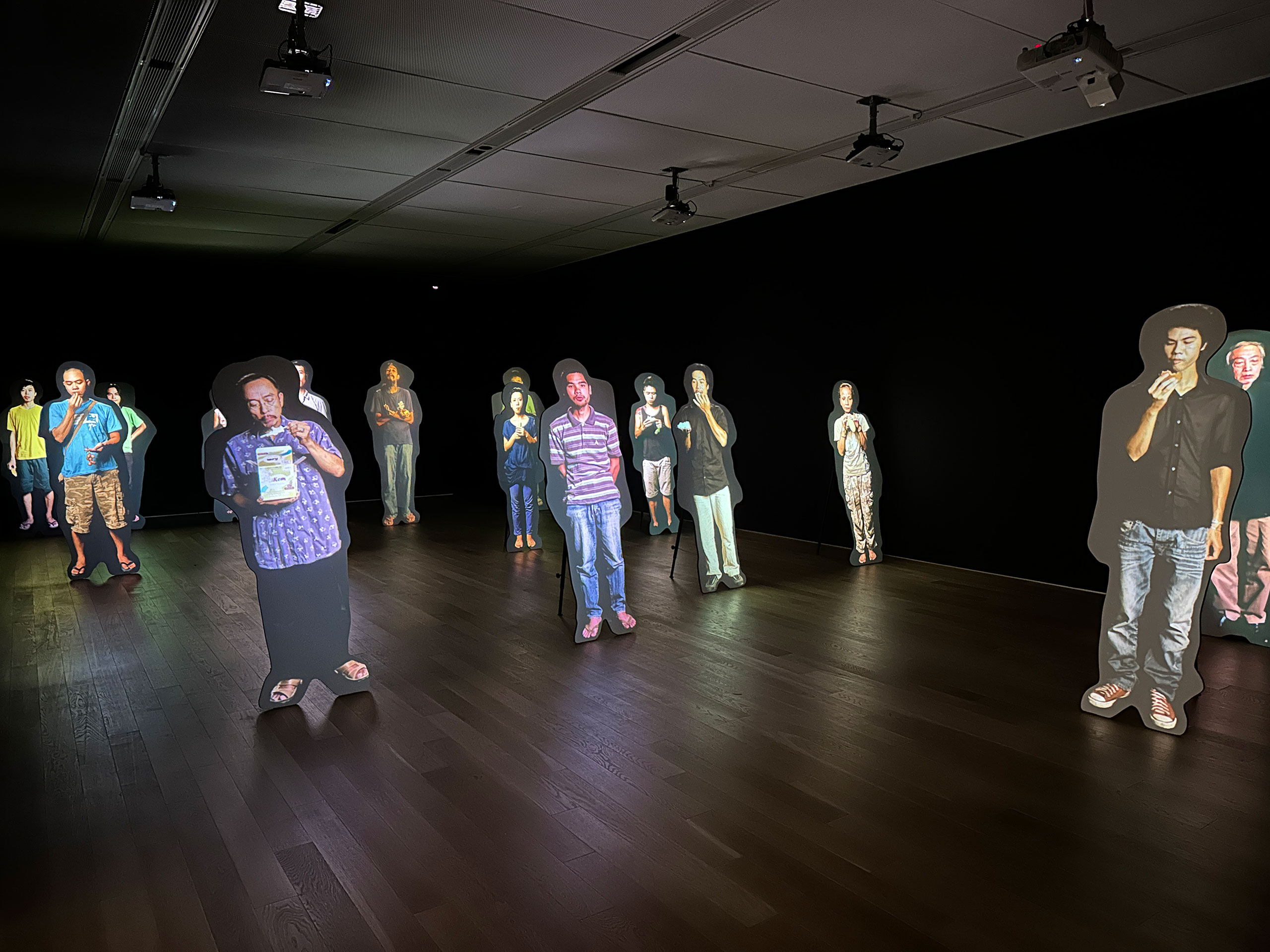
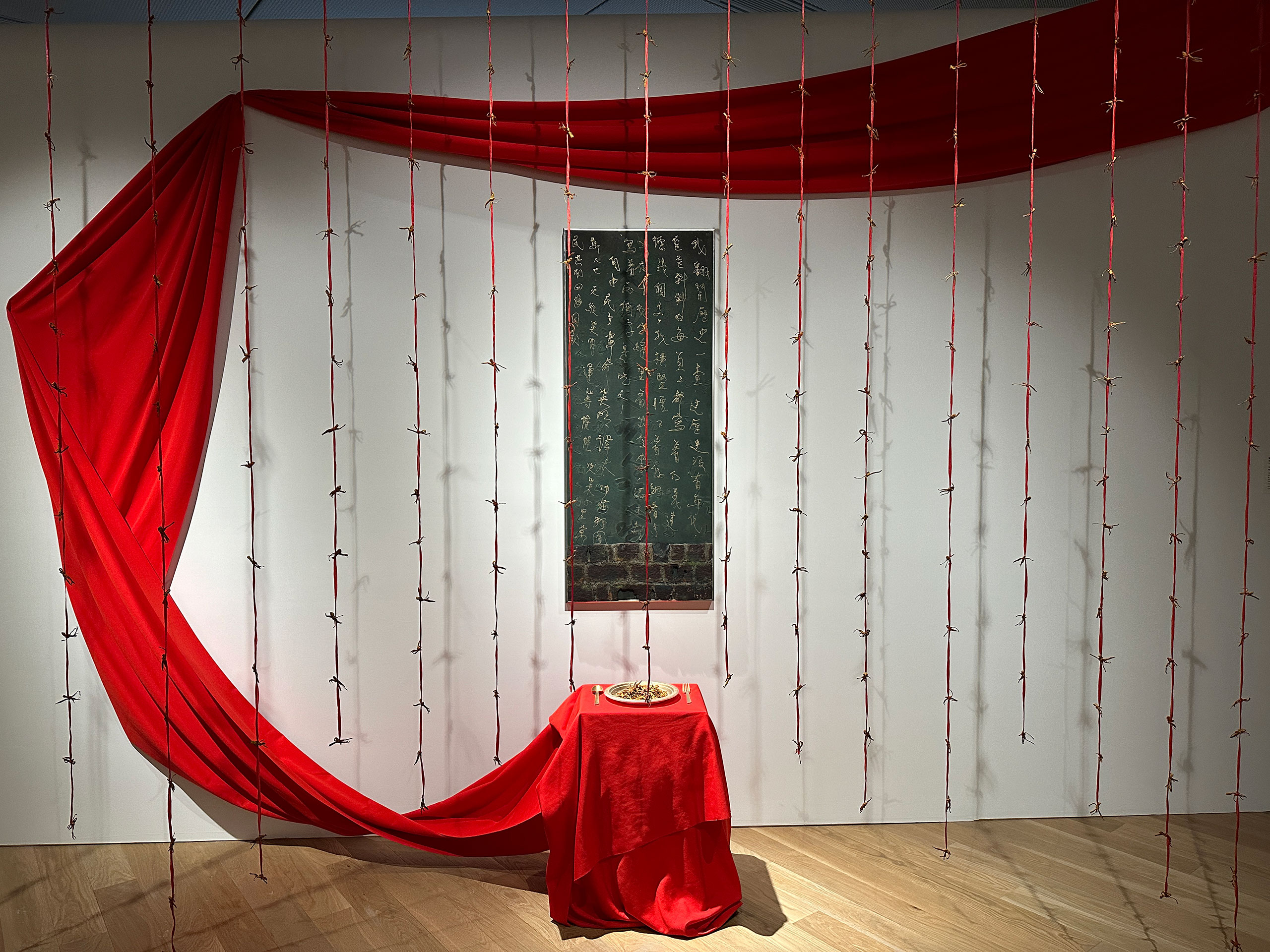
The concept of “speaking nearby”, articulated by Vietnamese American artist, filmmaker, and theorist Trinh T. Minh-ha, offers the orientation that feels most appropriate.1 To “speak nearby” is to refuse the traditional subject/object divide between the one who speaks and the one who is spoken about. It describes being close without substituting for or occupying the other. In other words, it rejects the stance of “I speak, I represent, I explain” in favor of a more humble, questioning relation—being present while maintaining distance, acknowledging difference, and leaving room for open interpretation.
Perhaps for this reason, I have chosen to respond to this exhibition in the form of a letter. I am not speaking from within it, but alongside it, allowing my language to unfold slowly. Let me, with my limitations and hesitations, approach you; and may you, from your own experiences, look back at the exhibition through these small openings.
The Multiple Contexts of “The South”
Before discussing Ocean in Us, I would like to briefly revisit the Kaohsiung Museum of Fine Arts’ 2019 initiative, the “South Plus: Constructing Historical Pluralism” special collection. The first chapter, South as a Place of Gathering, traced the introduction of modern art during the Japanese colonial period, focusing on how artistic communities in southern Taiwan developed practices such as painting societies and sketching. The second chapter, South as a Place of Changes, confronted the industrial city of Kaohsiung under martial law, examining how artists responded to and resisted political pressure, as well as critiquing the pollution resulting from rapid industrialization.
Ocean in Us, as the third chapter, breaks from the previous two by foregrounding women artists instead of male-centered narratives. Moving beyond the focus on southern Taiwan and embracing the spirit of the “South Plus” concept, the exhibition can also be read in parallel with Taiwan’s recent New Southbound Policy and contemporary art discourse around the Global South. Beyond Taiwanese artists, the exhibition features participants from eight Southeast Asian countries: the Philippines, Thailand, Vietnam, Indonesia, Malaysia, Myanmar, Singapore, and Cambodia. Drawing on the collections of KMFA alongside National Gallery Singapore and Singapore Art Museum, the exhibition is the product of a tri-institutional curatorial collaboration. The roster of works and artists is approximately equally drawn from Taiwan and Singapore, underscoring the curatorial team’s intention to cultivate a dynamic, reciprocal dialogue across regions.
This cross-contextual and trans-regional curatorial approach is perhaps also reflected in the exhibition’s title. The Chinese title, 珍珠 (“Pearl”), is inspired by the Chinese title of Elizabeth Pisani’s book Indonesia, Etc.: Exploring the Improbable Nation, which states “The Pearls that Gods Left Behind”, a reinterpretation by a Taiwanese publisher. The English title, Ocean in Us, draws on the concept of the Tongan scholar and poet Epeli Hauʻofa, who moves beyond the boundaries of islands and nations, proposing the ocean as a subject for thinking, thereby generating possibilities for transnational connection and solidarity. The divergence of titles does more than open multiple readings; it unfolds the exhibition into two realms: one, a tender, intimate world of named pearls; the other, a vast, flowing expanse of ocean. The exhibition thus weaves together these two sensibilities, a dialogue that continually stirs in the liminal spaces of language.
The term “pearl” carries an immediate sensibility: smooth, pure, round, lustrous, often associated with gentleness and femininity. Yet the formation of a pearl inherently involves pain—it is created as an oyster secretes layers of nacre in response to external irritation, a product of trauma and repair. Naming a women’s art exhibition, Pearl conveys both resistance and the possibility of mending, yet it inevitably invokes the imagination of suffering sublimated into beauty. It is indeed a fitting tribute to a generation of women artists, but how to further help audiences understand the historical context of these artists, and to resonate with contemporary women’s experiences, remains an open question.
Ocean in Us evokes an altogether different sensibility—fluidity, empathy, and collective interconnectedness. It reframes “the South” from a mere geographical notion into an epistemological position, akin to the hydrofeminist concepts increasingly cited in contemporary art, where oceanic connectivity and inclusivity intersect with women’s lived experiences. Yet if we return to Pisani’s depiction of Indonesia—“a ragbag of islands that had only a veneer of shared history, and little common culture”—we might extend this to the internal heterogeneity of East and Southeast Asia. “The South” is not a graspable totality; rather, it is a continuously shifting stance. It denotes geography, nation, and politics, yet also carries an affective summons—particularly in Taiwan, where the “South” is often romanticized as intimate and empathic. Yet even a tentative step closer immediately reveals the immense heterogeneity under a single name: multilingual realities, colonial histories, religious and cultural differences. In truth, we often know very little about the social and cultural structures of other Asian countries. Within the “South,” there are countless other “Souths,” a cacophony of voices and divergent narratives.