ISSUE 16 2025
Curating Speculative Feminism
ALOHA NŌ: What's Love Got to Do with It?

Introduction by Binna Choi

The following1 is a conversation held by three curators–Wassan Al-Khudhairi, Noelle M.K.Y. Kahanu, and myself–of Hawaiʻi Triennial 2025, somewhere in the middle of the preparation for the Triennial. The conversation foregrounds the process behind curating the Triennial, through which we also shape the meaning of ALOHA NŌ, the title and theme of the Triennial. The experiences of several exhibitions and projects over the last two decades that I curated have made me believe in the power that titles enact. While an exhibition/project title guides how different agents, whether it’s an artwork or thing, a person, a collective, or an institutional body, come together in a place and time, it operates, as I might even claim, like a magic spell. ALOHA NŌ is the latest case of it that I can present, that is saying NO to aloha being commodified, feminized and betrayed, with deep, grieving affirmation–NŌ in‘Ōlelo Hawai‘i (Hawaiian language)–of aloha as it is meant to be in native Hawaiian epistemology–that is, loving as an ultimate truth, loving as a way of being in touch with oneself, loving (un)learning from the ocean, loving for forgiving.

Breaking up is hard, wounds leave traces, but they may well be unavoidable. But healing is not impossible either. The question is who gets to do it? The contemporary art world, not unlike the rest of the world, is ridden with gender discrepancy and a lack in gender diversity, yet it’s the field wherein women take up the majority of work and labor–from cleaning to curating. Women-led or driven organizations tend to collaborate more with women, too. However, there is no case yet where male curators of no previous relationship or working experiences are invited to curate a biennial together by its commissioning organization, whereas there are several occasions for female curators, including those I came to be involved, Natasha or Singapore Biennale 2022 being one curated by Ala Yunis, June Yap, Nida Goush, and myself, and another Hawaiʻi Triennial 2025. Provided that a scene where a male (white) curator takes a leading role and has several other female curators in supporting roles is certainly familiar, but the situation of all female curators, especially with no hierarchy among them, may well be celebrated, yet only with caution. I am cautious since women are left to carry the work of care and healing in reducing their subjectivities and the figure of a male remains in the old image of power–sole, solid, and strong.

A basic yet fundamental lesson I take from various collaborative works I have experienced, whether they’re curatorial or not, is that when differences look impossible for making a synthesis in a given condition, they need to be simply acknowledged and left as they are. Then what a collective could do best is to make the connections between them in order to bridge singularities. Otherwise, you may well commit yourself to the synthesis emerging, although this needs to face and make its own conditions. This should not allow the dictatorship of consensus-based decision making or compromise but play with various methods for mutual understanding based on the necessary persistence. I hope that our process of curating Hawaiʻi Triennial 2025, as incompletely shared in this conversation, offers some possibilities for enabling collective curation, let it be among women or not– or rather, hopefully, among males, too, in all variations–yet based on the experience, history, and voices of women.

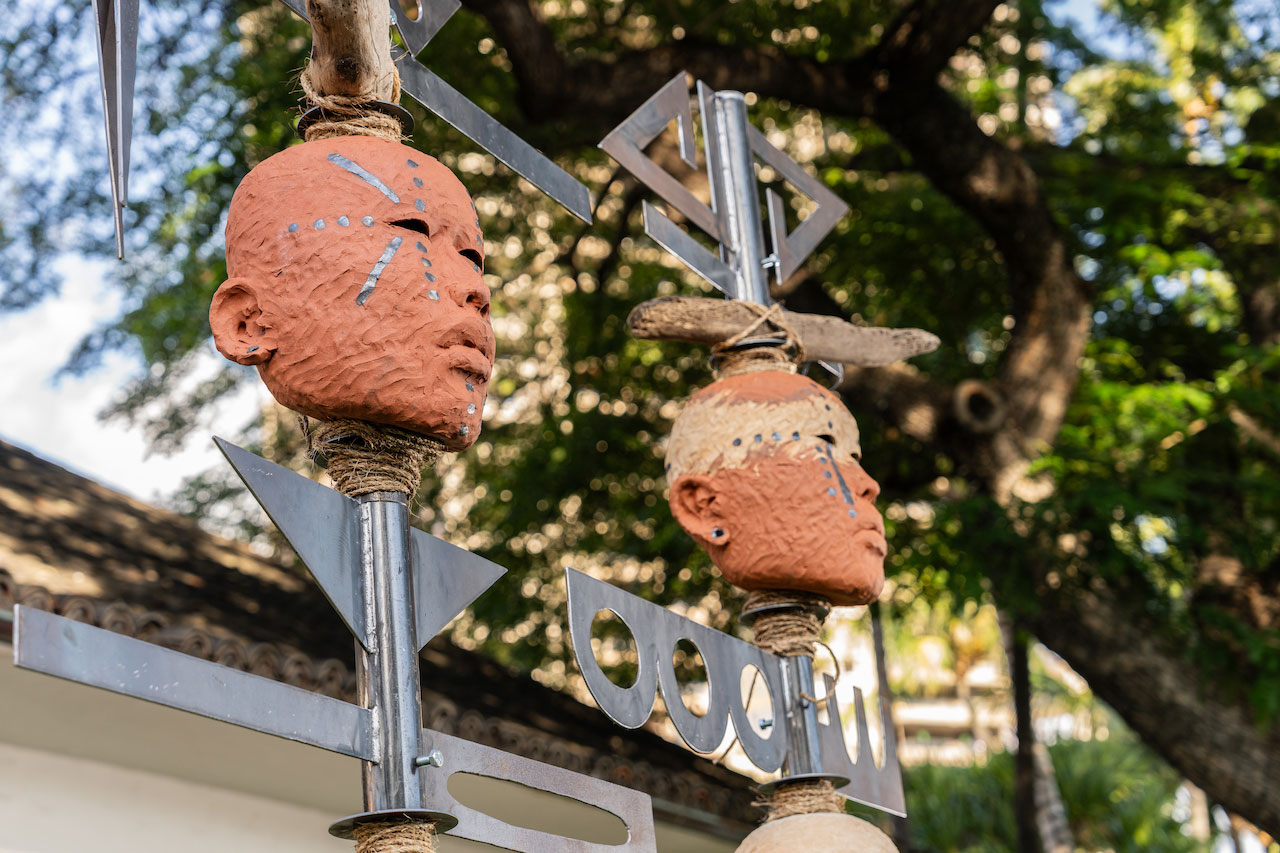
Rose B. Simpson, A'gin, 2025, installation, detail, Hawaiʻi Triennial 2025 by Honolulu Museum of Art. Courtesy of the artist and Hawai'i Contemporary. Photo by Duarte Studios.
Rose B. Simpson, A'gin, 2025, Hawaiʻi Triennial 2025 by Honolulu Museum of Art. Courtesy of the artist and Hawai'i Contemporary. Photo by Duarte Studios.
1 This conversation is also included in the forthcoming publication of the Hawaiʻi Triennial 2025: ALOHA NŌ, catalog.

‘He Alo A He Alo’2
(Face to Face)

He alo a he alo,


 (Face to face)

That’s how you learn about what makes us weep.

He alo a he alo,


 (Face to face)

That’s how you learn what makes us bleed.

He alo a he alo,


 (Face to face)

That’s how you learn what makes us feel.
what makes us work.
what makes us sing.
what makes us bitter.


 what makes us fight.


 what makes us laugh.


 what makes us stand against the wind


 what makes us sit in the flow of power


 what makes us, us.

Not from a distance.
Not from miles away
Not from a book
Not from an article you read
Not from the newspaper
Not from what somebody told you
Not from a “reliable source”
Not from what you think
Not from a cliff
Not from a cave
Not from your reality
Not from your darkness

But,

He alo a he alo,


 (Face to face)

Or,
else,
Pa‘a ka waha. 


 (shut tight, your mouth)

‘A‘ohe o kahi nana o luna o ka pali; iho mai a lalo nei;
‘ike i ke au nui ke au iki;
he alo a he alo.

(The top of the cliff isn’t the place to look at us;
come down here and learn of the big and little current,
face to face.)

And come and help us dig, the lo‘i, deep.

——Puanani Burgess

A Conversation Between Wassan Al-Khudhairi, Binna Choi, and Noelle M.K.Y. Kahanu

This conversation took place in June 2024 as we came together to reflect on the process of curating ALOHA NŌ, Hawaiʻi Triennial 2025 (HT25). Although the work was not yet complete and we were not ready to fully imagine the results of this undertaking, this conversation captures a moment in the process of making the triennial and offers a space to reflect on how we came to this point.

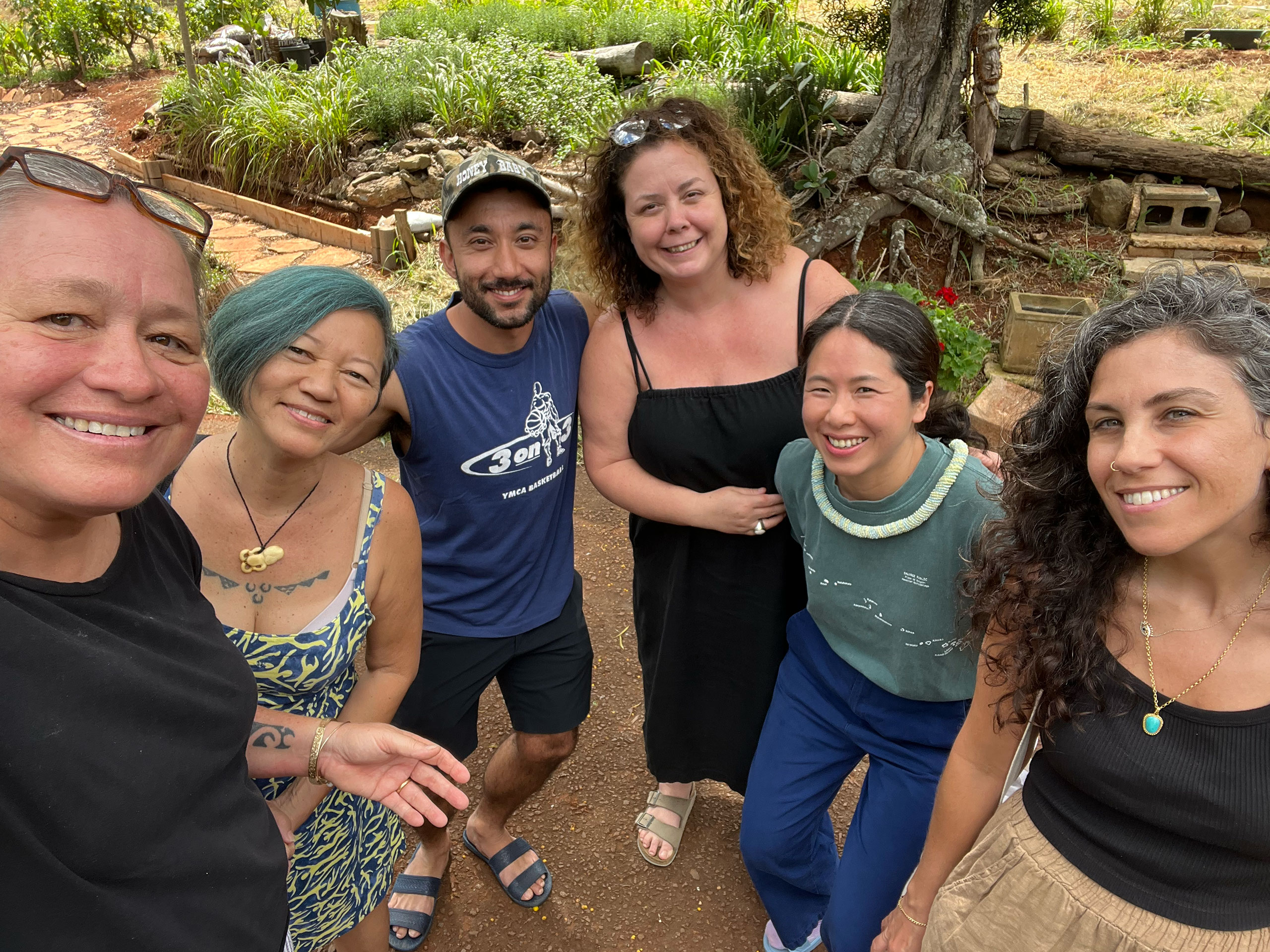
A HT25 curatorial team & organization’s volunteer day at Kākoʻo ʻŌiwi, 2 December 2022

Wassan Al-Khudhairi: One of the first things we did as a curatorial team was to volunteer at the lo‘i, or taro patch, at Kākoʻo ʻŌiwi on O‘ahu—it wasn’t sitting in a meeting room talking to each other, but being in the ‘āina, and I think it grounded this process. As an outsider who had never visited Hawaiʻi, this was a transformative experience; to stop, listen, and be changed by the land. Doing this with a large group of multigenerational communities, with the both of you, and the Hawai‘i Contemporary team—being knee deep in the lo‘i, covered in mud, feet gently pressing the roots while my hands nudged the taro from the ground—anchored me ‘in’ this place. It set the tone for how we would work together and established one of the threads that I think has developed as a core part of this triennial—moʻo, the Hawaiian word for continuity or succession—as a way to remind us that everything is interconnected.

Binna Choi: Some days after a lo’i day, and with my fingernails still filled with dirt, I met Maile Meyer, founder of Native Books and a Hawai’i Contemporary board member, and shared my concern about speaking of the Hawaiian philosophy, culture, and values as a haole wahine (foreign woman). Maile assured me, saying that I had shown that I have mud in my fingernails from the lo‘i, and I am speaking from that experience and connection.

Many Hawaiian and local artists are engaging directly with ‘āina by working in the lo‘i, weaving with hala, and other conservation work. Later on, we invited local HT25 participating artists to join the lo‘i at Ulupō Nui, which is taken care of by Nālamakūikapō Ahsing, also a participating artist in HT25. He sources most of his materials for his artwork from this place, such as trees for paper and stamping and plants for color painting; there’s a reciprocal relationship between him and this particular ‘āina. I think this mode of engagement can set an example for the rest of the world!

Noelle M.K.Y. Kahanu: As someone of this place, as a Kanaka ‘Ōiwi (native Hawaiian), I have watched the artistic endeavor of the Hawai‘i Triennial growing for a decade, from a fledgling concept and prologue exhibition in 2014 to a biennial in 2017 and 2019, and the Hawaiʻi Triennial in 2022. Many in the arts community, including myself, were initially skeptical—one more Asia-Pacific event with a capital “A” and small “p”. And yet, over time, it has taken root here—a direct reflection of Indigenous curatorial representation.

A moment came when I could have chosen to remain an observer or become a part of this unfolding legacy. I said yes, despite having a largely ethnographic museum background. The contemporary art realm is sometimes mystifying, and I felt most comfortable when we were wrestling with Hawaiian concepts like our theme of aloha nō. We felt strongly that it was time to embrace a theme in ‘Ōlelo Hawai‘i (Hawaiian language) and that it did not need an English translation but could stand on its own as an invitation to learn more.

Aloha is such an over-commodified word, and we struggled with its use, circling around and away but ultimately circling back. There was a precious moment on Maui during a pre-HT25 small town-hall meeting on the grounds of the Bailey House Museum. My Auntie Ellen Raiser was there, and she said very clearly, “Aloha is something that we want to share, but something that also has to be defended.” This really solidified for me the potentialities of this theme and the creative opportunities that present themselves when we really lean into the tensions and complexities of aloha nō.

BC: As the fourth iteration, HT25 is built upon past iterations, and its meaning and how this continuity is woven through might be articulated further; otherwise, the success of a biennial or triennial is often premised on innovation and differences only. Personally, I am indebted to the 2022 edition of the Hawai‘i Triennial, Pacific Century—E Ho‘omau no Moananuiākea, curated by Drew Kahuāina Broderick, Melissa Chiu, and Miwako Tezuka, which brought me to Hawai‘i for the first time—and to HT25 artist Sung Hwan Kim for encouraging me to come—as well as to initiatives such as Native Books and Aupuni Space, which nurture the artistic and cultural ecosystem in Honolulu. In particular, the HT22 ‘Elepaio Press installation at Hawai‘i State Art Museum (HiSAM), now known as Capitol Modern, enveloped me within the context of Hawaiian anti-colonial political struggles, the importance of native and non-native collaboration, and the position of these in Moananuiākea and the broader Pacific region, alongside all kinds of connections and exchanges among artists, poets, and writers that burgeoned from the 1970s, when the so-called Hawaiian Renaissance movement rose up. Work by Wayne Kaumualii Westlake, Richard and Mark Hamasaki, and Paul L. Oliveira, including the journal Seaweeds and Constructions, was an amazing conduit for this.

Especially when I came across Westlake’s poem “Down on the Sidewalk in Waikiki” (1973) through Mark Hamasaki’s photographic montage work Down on the Sidewalk … (2021) at HiSAM, it opened a deeper sense of understanding and connection to Hawaiian history, almost like facing a wound that is healing. The poem includes the lines, “last year I spent working as a janitor down on the sidewalk in waikiki—experiences ran from everything to everything. I wrote poems to keep from going insane.” The poem captures the harm colonialism causes; but it also turns the popular colonial idea of Waikīkī upside down and shows what art can do. We might say aloha nō is imminent in the HT22 edition of the triennial, as it is in this work, or the seeds were planted and they are growing with us

WA: As someone who is new to Hawai‘i, learning about Hawaiian history and all that its people have endured in the past and continue to navigate today in an occupied place, I feel there is much to learn from Hawaiian values and traditions; that these could offer us other ways of understanding the complex world we are living in and we can use these teachings to envision new ways of being in the world with one another.

When we began thinking about HT25, we were trying to project what the local and international context would be in February 2025, knowing that there would be major global economic and political changes. Since we began work on the exhibition, the Ukraine war has continued, Israel has committed genocide in Palestine, and issues of climate change such as rising sea levels persist. The United States is on the verge of an electoral civil war where not even the presidential election process is safeguarded.

With all this uncertainty, we have been thinking about how to make a triennial that could speak to and maybe even offer up other ways of thinking about and navigating these realities. It’s challenging to make an exhibition for a future context that we canʻt predict.

NK: I think many visitors to Hawaiʻi do not know its colonial history. At the crux is the illegal overthrow of the Kingdom of Hawaiʻi in 1893 by a handful of American and European businessmen. These opportunists took advantage of a constitutional dispute and turned it into a ‘crisis’, insisting that over 160 armed US marines be landed to protect American lives and property. Queen Liliʻuokalani yielded her authority to the United States because she feared the bloodshed of her people and because she hoped the US would soon undo this injustice. Instead, Congress illegally annexed Hawaiʻi by a simple majority through the Newlands Resolution in 1898. The normal treaty process requires a two-thirds majority of the Senate, but, because more than 38,000 Hawaiians signed petitions objecting to annexation, the first vote failed. In an act never seen before or since, the US annexed the territory of another against its will, by resolution; by a simple majority and by the same authority that Congress uses to recognize National Apple Pie Day.

I think people need to understand that the events of the past continue to live very much in the present. We hold these histories within our bodies and experience them generationally. So, as curators, we have been asking ourselves, how might a triennial be a platform by which to experience these enduring contestations? Taking a cue from this history, we even flirted for a moment with Haunani-Kay Trask’s infamous words “We are not American” as a means of saying that where this triennial takes place matters. This history matters. Such a position informed our artist selection—as we considered places with similar colonial or conflicting histories and present realities. We have attempted to take these matters to heart within the kaona (multiple meanings) of aloha nō, with “nō” being both an expression of intensification and an allusion to refusal. It has become our touchstone. We would leave, be momentarily enticed by another idea, then return.

BC: The ambivalence of the expression aloha nō is both the challenge and power of our theme; its meaning is supposed to be undulating, depending on the context and situation. For most people—both in and out of Hawai‘i—the expression might at first be read as a form of negation, unsettling the familiar and recognizable Hawaiian greeting and stereotypical image of Hawai‘i as a (holiday) paradise. In order to know the full meaning of the title, one needs to be familiar with Ōlelo Hawai‘i and understand that nō is rather a deep affirmation, intensifying the meaning of aloha.

At one point, I felt disturbed by the idea of this wordplay, and concerned that the title would appear negative for many, in a time where there is so much negativity and political instability. I am cautious that sometimes forms of resistance might fall into the logic of the enemies they resist, and I am glad that we have made sure that the emphasis is on the affirmation. Keeping the kahakō, or macron, on the nō helps people to understand there is more at stake than the English no, and we have this responsibility to lead from not knowing to knowing, from anger and resistance to deepest affirmation and love. In fact, as we learnt from Aunty Manulani Aluli Meyer, in Hawaiian epistemology, knowing is nothing but loving.

It is not an easy task to make an exhibition that enables the experience of loving, and loving as the ultimate truth. One of the challenges lies in our curatorial process and practice, which embraces an exhibition but surely goes beyond it. We have been adamant that we cannot display aloha while the process of making the exhibition is filled with that which contradicts aloha. In fact, in Aunty Manu Meyer and Nāpali Aluli Souza’s essay for the Honolulu Biennial 2017 catalogue, writing about how the exhibition can serve pilina, they ask, “Can Hawai‘i maintain the Aloha Spirit that has made us distinct in the world, or do we collapse into mainstream art rhetoric based on a-cultural assumptions of power and money?” I also love and carry with me a statement they made: “The mo’o runs throughout all of life, but she lives where aloha finds safe harbor.”

That we are centering Indigenous Hawaiian values through aloha as the source of these values also invites us to engage with the notion of tradition and traditional cultural practices. Without the ongoing conscious effort to preserve and perpetuate Hawaiian traditional practices such as kālai ki‘i, hula, storytelling, and even the language, all might have been erased. Yet, engaging with tradition, as much as with identity, can also fall into a trap of othering, xenophobia, and commodification, which I have seen in Korea and, in its extreme version, in the right-wing nationalist movements of Europe. I do love the idea that it’s aloha—love—that ensures continuity, not the definition and boundaries of tradition, not an ideology or any other logic of power. Do you remember our visit to Uncle Sam Ka‘ai in Maui, the beloved orator and cultural icon? In the same vein, it was so liberating and exhilarating to hear through his storytelling that the word Hawai‘i is not just found in Hawai‘i, but also in Aotearoa, Samoa, Tonga, and even in the Strait of Malacca; that the word “Hawai‘i” means “homeland”!

A HT25 curatorial team & organization’s visiting and meeting with Manulani Aluli Meyer at her home, Palelua, Honolulu, 17 April 2023

WA: It’s also thinking about the work of the triennial as an opportunity to open up the dialogue to Hawaiian artists, artists in Hawai‘i, those in the Pacific, and artists around the globe. And the words of Aunty Manu Meyer really catalyzed that idea for me—that aloha is something that is Hawaiian, but also something that Hawai‘i can offer the world and that the world can learn from Hawai‘i.

NK: When it comes to aloha nō, the question we debated with was to kahakō or not to kahakō. Hawaiian-language newspapers do not use these glottal stops and other markers. Why should we? Are we being clever by being ambiguous? And to be honest, it became exhausting—the circular nature of our conversations. In the end, we chose to be extra loving. To manifest the intentionality of aloha nō. We needed it—organizationally and curatorially. We still do. The lesson we need to learn is, how do we manifest aloha nō with each other, with our artists, partners, and venues? How do we tend to it and make it grow?

Aloha nō has been our guiding theme, but also a methodology for how we work. It hasnʻt been without itʻs challenges—to love deeply, to engage deeply is also vulnerable, and in this work we have encountered resistance and moments of rupture. These moments are just as important to the process and are teaching us about hoʻopono and aloha in new ways.

BC: A kind of magic happened in this process when our visual identity designer, Welcome Stranger, suggested the pewa as a design concept for our theme. We were excited by their interpretation of the kahakō of nō as the symbol of the pewa.

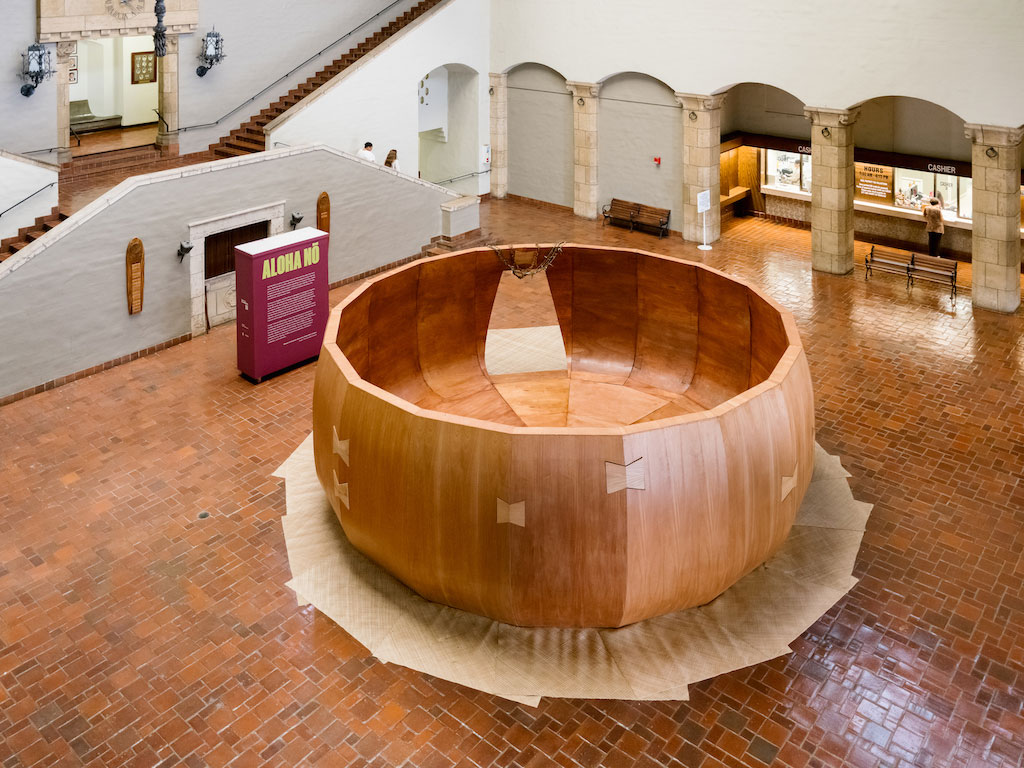
NK: Yes. The pewa is commonly known as a fishtail or butterfly patch and is used by Hawaiian woodworkers to mend fractures in objects such as “umeke,” wooden bowls. The wood of a pewa needs to be strong to hold the two split sides together and, in that sense, the repair needs to be stronger than the rift. As a pattern, it can also be found in kapa (barkcloth), on ipu pāwehe (decorated gourds), and in uhi (tattoos) and often represents healing. It became clear that our theme not only addresses what it means to love intensely, but that it carries with it the capacity for art to address the unsayable, to speak to what we bury deep within, and to begin the healing process. Using a pewa does not hide the pain; rather, it beautifies, heals, and returns function to our purpose.

Meleanna Aluli Meyer, 'Umeke Lā'au : Culture Medicine, 2025, Hawaiʻi Triennial 2025 by Honolulu Hale. Courtesy of the artist and Hawai'i Contemporary. Photo by Duarte Studios.

BC: Healing is definitely a key undercurrent for ALOHA NŌ, alongside several other sub-themes. This reminds me that we left it open as to how we would articulate those thematic strands—each as a chapter or layered and presented through the show for a while, and eventually made it more like a palimpsest. Our curatorial approach and methodology is an ʻāina (place)-based methodology, insofar as we are centering Indigenous Hawaiian knowledge and practice. Meaning, we are not just utilizing each of the fourteen institutions and sites as a neutral container and assigning them a theme out of our will, but seeing and relating to the context and genealogy of each. This influences the way we place artworks and articulate the theme; it’s not simply a one-way direction, rather there are many dances we do with different factors and conditions that each place brings forward.

NK: Yes, in multi-site exhibitions, I often find myself wondering how the venue factors into the artist selection or vice versa. For HT25, we are trying to highlight certain sub-themes and to tie these ideas into the venues and artist selections. For example, one of the themes I gravitate to, which we have already discussed, is the notion of healing. Keone Nunes, a well-known artist, practitioner, and cultural leader, once told me that when he goes to the collections of Bishop Museum and he’s looking at the “umeke” (wooden bowl), he finds that those with the cracks and pewa repairs are the most beautiful ones. It’s not the pristine bowl, but the one that’s been loved and used and fixed. It bears the markings of that love. It is the repair and reuse that shows it has become an heirloom—the most beloved of all.

I believe artists serve as our pewa—they help us to identify societal cracks and do their best to mend us and bring us back together. Several of our artists address suicide, which is so prevalent in our communities. We are working with questions such as, how does art help us to face things that we don’t want to talk about, or to put a public face on our personal tragedy? How does art tend to the soul and to one’s spirituality? To push this further, how might we tie this thread to a site or its particular history? How do we find a way for the audience to experience a theme on multiple levels through the specificity of both the site and the artist selection? Where will this iteration fit within the history and future of the triennial?

For the first time, we are expanding to the leeward side of Oʻahu; for the first time, we are on multiple islands; for the first time, we have nearly fifty participating artists. Curatorially, it is the first time we have had three women curators of color, working non-hierarchically. I hope that the pewa will hold and that in the process we will create something more beautiful than where we began. That multiple communities, youth, families, kūpuna, the artists, and ourselves are transformed, experientially and emotionally.

We don’t want this to only be a show about softness and tenderness and loving and healing, but rather to embrace the complexity of aloha nō as a form of resistance.

BC: Indeed, in resisting the “feminization” of the notion of aloha and love, we have quite a few artists who are taking the figuration of women in art as a tool to reposition women and their bodies and labor in the history of colonial and capitalist violence, which continues today in the so-called ‘crisis’ of immigration, through domestic violence, and in the patriarchal historiography that erases the position of women. They manifest fearless, powerful, transformative forms of loving.

I have also been falling in love as well as grappling with the notion of the sovereign and sovereignty while working on HT25. As a feminist Korean woman, I am weary and cautious of nationalism, which is most often patriarchal in nature and employed as propaganda by right-wing conservative parties. However, Hawai‘i’s history and the current political and intellectual discourse illuminate different ideas of sovereignty, or ea’ in Hawaiian, and empower those who have the experience of being subjugated, helping us imagine the future of governance in a broad scope beyond the human or a state-centric approach.

2 By Puanani Burgess. First published in He Alo Ā He Alo (Face to Face): Hawaiian Voices on Sovereignty (American Friends Service Committee, 1993), xi. The version reproduced here appeared in A Handbook of Poetry Basics: Poems by Puanani Burgess, self-published by Burgess. As noted by the author, ‘All works in this book may be used and reproduced as long as the original author, Puanani Burgess, is given credit and is referenced in the reproduction. May it bring joy and peace to future generations of the world.’

Jamaica Heolimeleikalani Osorio’s citing of Kamehameha III’s expression “Ua Mau ke Ea o ka ʻĀina i ka Pono” (The life of the land is perpetuated in righteousness) during her keynote at the 13th Festival of Pacific Arts & Culture (FestPAC) in June 2024, argues for a move away from a narrow concept of ea and for the expression to be read with an emphasis on ʻāina. The sovereign belongs to ʻāina, not to any one person. Creating and holding pu‘uhonua, or sanctuary for one another3, is where sovereignty is located.

Osorio is also speaking from her experience of taking part in the Thirty Meter Telescope protests in 2019 against the expansion of observatories and the building of more telescopes on Mauna Kea. The expression aloha ʻāina can be translated into love of/for land and is daring and invaluable for all of us beyond Hawai‘i. It refers to a movement to restore the way land was cultivated in pre-colonial Hawai‘i, namely through lo‘i kalo (taro patch) and fishponds, but also to the movements that fiercely protect both nature and the sacred, such as Protect Kaho‘olawe ‘Ohana, which was highlighted in HT22, and the protests on the summit of Mauna Kea. This is the way Hawaiian nationalism and its fight for sovereignty can be understood, and can inspire us all—whether Native, settler, foreigner, or tourist in Hawaii—as here we can find solidarity beyond any existing nation-state.

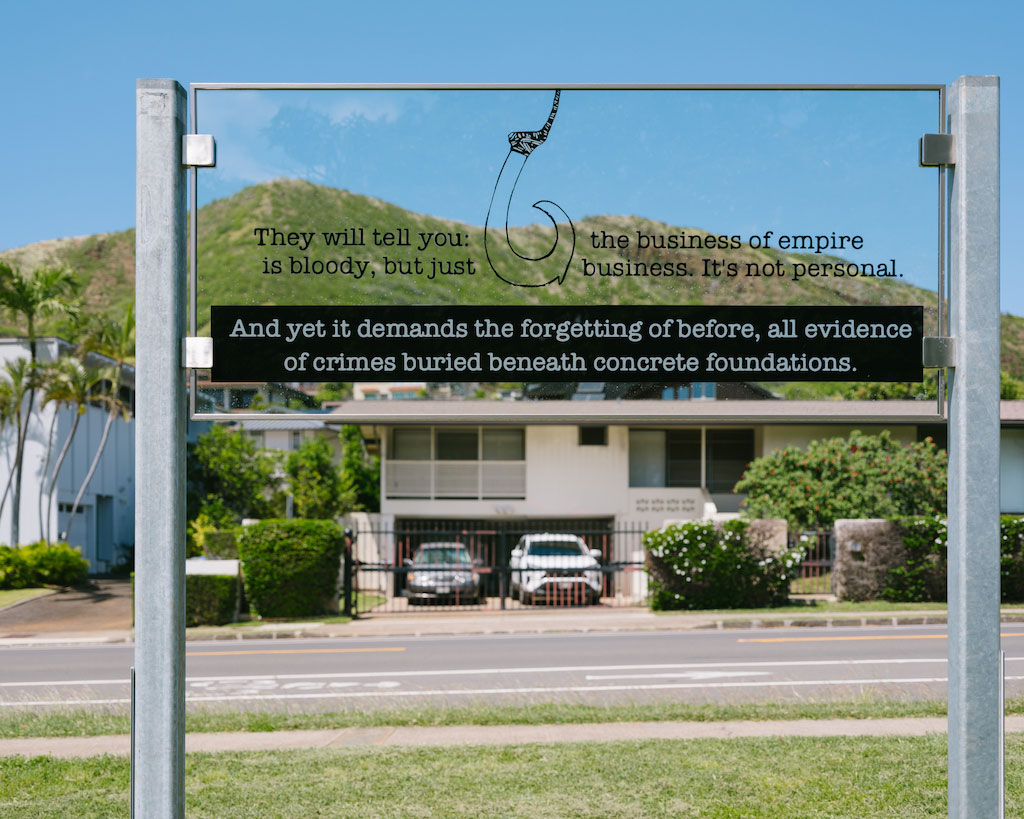
Brandy Nālani McDougall, Aloha Aupuni, 2025, around Lēʻahi, Hawaiʻi Triennial 2025 in collaboration with Wahi Pana. Courtesy of the artist and Hawai'i Contemporary. Photo by Lila Lee.

WA: Aloha ʻāina, also meaning that which feeds us, is, as you say, Binna, not just about caring for or loving land—it’s also a way toward sovereignty. Osorio also said in that same FestPAC speech: “What good is sovereignty if there is no care?” There are many incredible groups in Hawai‘i working together to steward the land. Hawai‘i ‘before contact’ was abundant and produced enough food to feed its population. The complex agricultural systems established and maintained during the Hawaiian Kingdom worked—but then came colonialism, the military, tourism, and capitalism. As imperialist projects do, the ecosystem was destroyed and the local population—what remained after the spread of disease—was left unable to provide food for themselves. Aloha ʻāina is about sovereignty.

As mentioned, another guiding light for us through this process has been the strength and power of Haunani-Kay Trask’s words. A leader, among many, of the Hawai‘i sovereignty movement, her 1993 statement that ‘We Are Not American’ lives on today; I’ve seen it on posters and stickers, and on t-shirts at Palestinian solidarity marches and sovereignty events across O‘ahu. Trask looked to anti-imperialist movements of the 1960s and 70s and was incredibly powerful in her ability to express the interconnectedness of the Hawaiian sovereignty movement. In her activist work she made connections between Hawai‘i and Palestine, the Irish and Basque struggles for independence, and other colonized groups of people. She inspired us to think about aloha nō more broadly—to bring into the triennial artistic perspectives from places such as Cuba, Puerto Rico, and the Philippines, whose populations also suffer the impacts of US imperialism.

The making of this triennial is taking place alongside a Palestinian genocide that the world has not been able to stop despite the violation of so many U.N. laws; Israel has bombed schools, hospitals, and refugee camps. O‘ahu has offered community for me during these unfolding (and never-ending) atrocities. There’s an understanding here of what it means to be occupied.

HT25 artist and current poet laureate of Hawai‘i,Brandy Nālani McDougall, said during her remarks at Art Summit 2024 that liberation is bound up in that of others—that she thinks of this in terms of outward circular motions, of looking outward while looking inward at the same time; she says it’s centripetal and centrifugal. Her poem “Kūpikipikiʻō” is about transnational solidarity, placing the reader in Hawai‘i while weaving us in and out of Hawai‘i, pointing to the multiple connections across the globe suffering from US domination. When I first heard her recite this poem, I felt a deep sense of sadness and connection as she read: “Stand here, at the breaking edge of Iraq, Iran, and Afghanistan as the American military invades and raids their oil fields, as the US chooses their leaders and builds Middle Eastern bases.” Here I was, an Iraqi woman sitting on the grass at the Bishop Museum in Honolulu—a place I thought was the furthest point from my homeland—finding a connection so deep I was moved to tears.

We all want to be seen, felt, heard. What brings us together in this moment is pain—but finding each other in the most unexpected places is the humanity the world is seeking today. By inviting artists to think about these ideas, we are hoping HT25 will also create an invitation to the public to enter into these conversations and to situate themselves within these stories—to ask questions of themselves, to find their kuleana (responsibility).

3 Osorio attributes this lesson to artist Joy Lehuanani Enomoto.

1 This conversation is also included in the forthcoming publication of the Hawaiʻi Triennial 2025: ALOHA NŌ, catalog.

2 By Puanani Burgess. First published in He Alo Ā He Alo (Face to Face): Hawaiian Voices on Sovereignty (American Friends Service Committee, 1993), xi. The version reproduced here appeared in A Handbook of Poetry Basics: Poems by Puanani Burgess, self-published by Burgess. As noted by the author, ‘All works in this book may be used and reproduced as long as the original author, Puanani Burgess, is given credit and is referenced in the reproduction. May it bring joy and peace to future generations of the world.’

3 Osorio attributes this lesson to artist Joy Lehuanani Enomoto.

Share
Email
Twitter
Facebook
Author

Binna Choi is a South Korean curator whose practice interconnects art, the curatorial, and the (sovereign) commons with respect to the politics of decolonization, indigenous practice and epistemology, and institutional change with unlearning. She directed Casco Art Institute: Working for the Commons in the Utrecht, the Netherlands for over a decade, where she curated projects such as Grand Domestic Revolution (2009–2012 with Maiko Tanaka and Yolande van der Heide), Site for Unlearning (Art Organization) (2014–2018 with Annette Krauss and the evolving Casco Team), Travelling Farm Museum of Forgotten Skills (2018–2022 with The Outsiders), along with a number of commissions and experimental collective works. Together with You Mi, she also maintains a study platform, Unmapping Eurasia.  Besides, Choi also served as a curator/co/artistic director for biennials such as the 2025 Hawai‘i Triennial, the 2022 Singapore Biennale, and the 2016 Gwangju Biennale. For the upcoming 2026 Venice Biennale, she curates the Korean Pavilion. In the context of pedagogy, she served as faculty for Dutch Art Institute for over a decade, and the guest professor for the Gwangju Biennial International Curator Course 2025. Since 2024, Choi also works as the supervisor for Doosan Curator Workshop.

Wassan Al-Khudhairi is an accomplished curator and arts leader known for her creative, entrepreneurial thinking and curatorial achievement across global institutions. She is currently based in New York, where she is Partner at C/O: Curatorial Office with Christopher Y. Lew. C/O brings curatorial thinking beyond museum walls. Most recently, Al-Khudhairi was part of the curatorial team for the 2025 Hawaii Triennial. This followed her tenure as the Ferring Foundation Chief Curator at the Contemporary Art Museum St. Louis (CAM), where she organized exhibitions and new commissions with artists including Lawrence Abu Hamdan, Bethany Collins, Derek Fordjour, Shara Hughes, Hayv Kahraman, Gala Porras-Kim, Paul Mpagi Sepuya, and Hajra Waheed. At CAM she co-produced the Radio Resistance podcast, which accompanied the thematic exhibition Stories of Resistance. Al-Khudhairi served as the Founding Director of Mathaf: Arab Museum of Modern Art in Qatar, overseeing its successful opening in 2010. Her extensive international biennial experience further includes serving as co-curator for the 6th Asian Art Biennial in Taiwan (2017) and co-Artistic Director for the 9th Gwangju Biennial in South Korea (2012).

Noelle M.K.Y. Kahanu (Kanaka ʻŌiwi/Native Hawaiian) is a 15-year veteran of Bishop Museum in Honolulu, where she developed scores of exhibitions and programs. She worked on the major renovations of Hawaiian Hall (2009) and Pacific Hall (2013), as well as the landmark E Kū Ana Ka Paia: Unification, Responsibility and the Kū Images exhibition (2010). She has a law degree from the University of Hawaiʻi at Mānoa and previously served as Counsel to the U.S. Senate Committee on Indian Affairs in Washington, D.C., where she worked on issues affecting Native Hawaiians, American Indians, and Alaska Natives. She is currently an associate specialist in Public Humanities and Native Hawaiian Programs in the American Studies Department at University of Hawai‘i at Mānoa. Her current research and practice explore the liberating and generative opportunities when museums “seed” rather than cede authority.

Sponsor
ARCHIVE
SPECIAL ISSUE
×

Curatography Issue 16 - Curating Speculative Feminism

Curatography Issue 15 - What Is to Be Done in Curating?

Curatography Issue 14 - Curating and Re‑public / Re‑commons

SPECIAL ISSUE - It’s Us, Not You: Curatorial Notes on the 6th Asia Triennial Manchester

Curatography Issue 13 - The Economy of Curation and the Capital of Attention

Curatography Issue 12 - Grassroots Curating in Asia

Curatography Issue 11 - Ethics of Flourishing Onto-Epistemologies

Curatography Issue 10 - Exhibition Amnesia, or, the Apparatus of Speculative Exhibition

Curatography Issue 9 - Curating Against Forgetting

Curatography Issue 8- Reformatting documenta with lumbung Formula: documenta 15

Curatography Issue 7 - The Heterogeneous South

Curatography Issue 6 - The Beginning of Curating

Curatography Issue 5 - Curatorial Episteme

Curatography Issue 4 - Curatorial Consciousness in the Times of Post-Nationalism

Curatography Issue 3 - Curating Performativity

Curatography Issue 2 - Curators’ Living Rooms

Curatography Issue 1 - Curatography