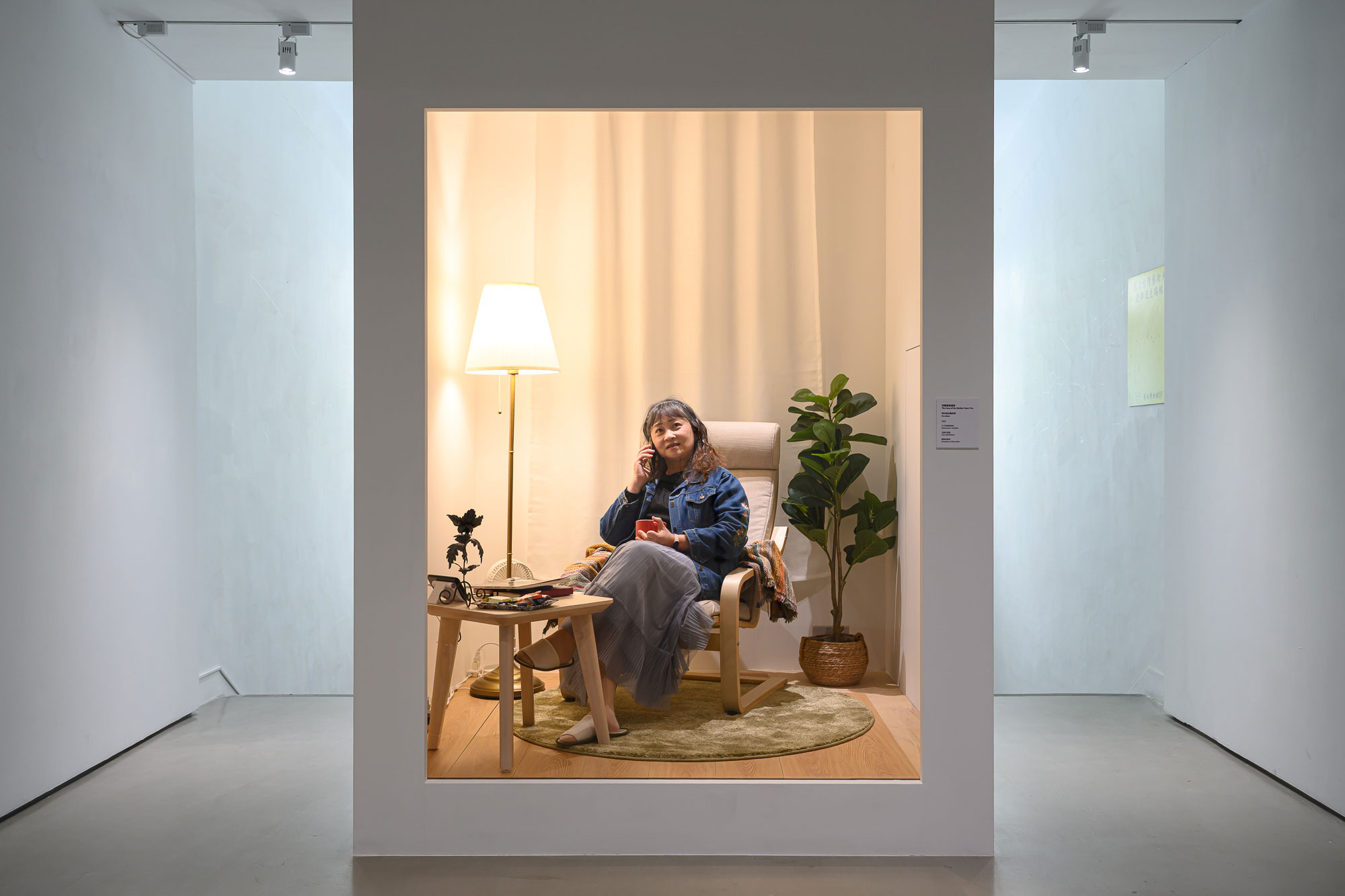
The Silencing of “Mother”
One cannot ask, “Who is Venus?” because it would be impossible to answer such a question. There are hundreds of thousands of other girls who share her circumstances and these circumstances have generated few stories. And the stories that exist are not about them, but rather about the violence, excess, mendacity, and reason that seized hold of their lives, transformed them into commodities and corpses, and identified them with names tossed-off as insults and crass jokes. The archive is, in this case, a death sentence, a tomb, a display of the violated body, an inventory of property, a medical treatise on gonorrhea, a few lines about a whore’s life, an asterisk in the grand narrative of history.3
—— Saidiya Hartman, Venus in Two Acts
Looking back, the demands we put on our mothers when we were growing up was treated as natural; when faced with a distant or ineffectual father, the phrase “men just aren’t good at expressing themselves” became a kind of panacea.
Within our dominant cultural narratives, there is no place for a “good mother” who is unwilling to sacrifice herself for the family. In the film and television works that accompanied our upbringing, from Star Knows My Heart (1983) to Little Big Women (2020), the qualities of a “good mother” are consistently bound to domestic competence, reinforcing the myth of motherhood: a “good woman” must take on the work of a housewife, must dedicate herself to the family. The negative models absorbed by a generation of “Michelle Chens,” in series such as The Heart with a Million Knots, Outside the Window, and Romance in the Rain, depict “bad women” with a shared set of traits: financial independence, careful self-presentation, and a commitment to articulating their own emotional needs. The subtext of mainstream culture is clear: we do not permit “mother” to feel worn out by, or resistant to, the demands of care. She must regard it as a sweet suffering that she must learn to endure.
As we peel back the sugary coating of the “myth of motherhood,” a carefully orchestrated trap gradually comes into view. The role of the housewife, long constituted by unpaid labor, has sacrificed women’s bodies and time to supply the patriarchal order with free domestic work. In a capitalist world, what cannot be quantified effectively does not exist; domestic labor is kept outside monetary calculation, erasing its value and diminishing women’s significance and influence within the larger social structure. This mechanism also sets up a “tortoise and hare” dynamic in any competition between genders, ensuring that women devote most of their energy to the minutiae of daily household tasks, leaving only their remaining fragments of time and strength for self-development or self-expression. It prevents women from easily entering leadership roles or becoming part of heroic narratives.
When viewed through the lens of “heroic history”, a mother’s labor in sustaining a household appears trivial, not even worth mentioning, much like the countless nameless women in the history of art who were referred to simply as “muses”. The occasional praise for motherhood resembles awarding an “employee of the year” title, harmless and inconsequential. Or, the mother is framed through a slightly sympathetic filter, positioned as a “victim,” as though she must be a fragile injured party in order to be worthy of notice, her vulnerability and pleas for help required to fit the damsel-in-distress storyline. In this way, narratives about women cannot be separated from tragic descriptors.
Buried beneath the accumulated weight and oppression of history, the mother before us has gradually become distorted, unsure of herself and silenced by the multiple constraints imposed on her labor, emotions, thoughts, and affect. How might we help her take off her work clothes, hold her, touch her face, and allow her to see herself in an unburdened state? To let her speak of every pleasure and every anger, every love and every hate, everything great and small.
I set aside mainstream narratives and the dominant historical frameworks and research methods.
Them and “Her”
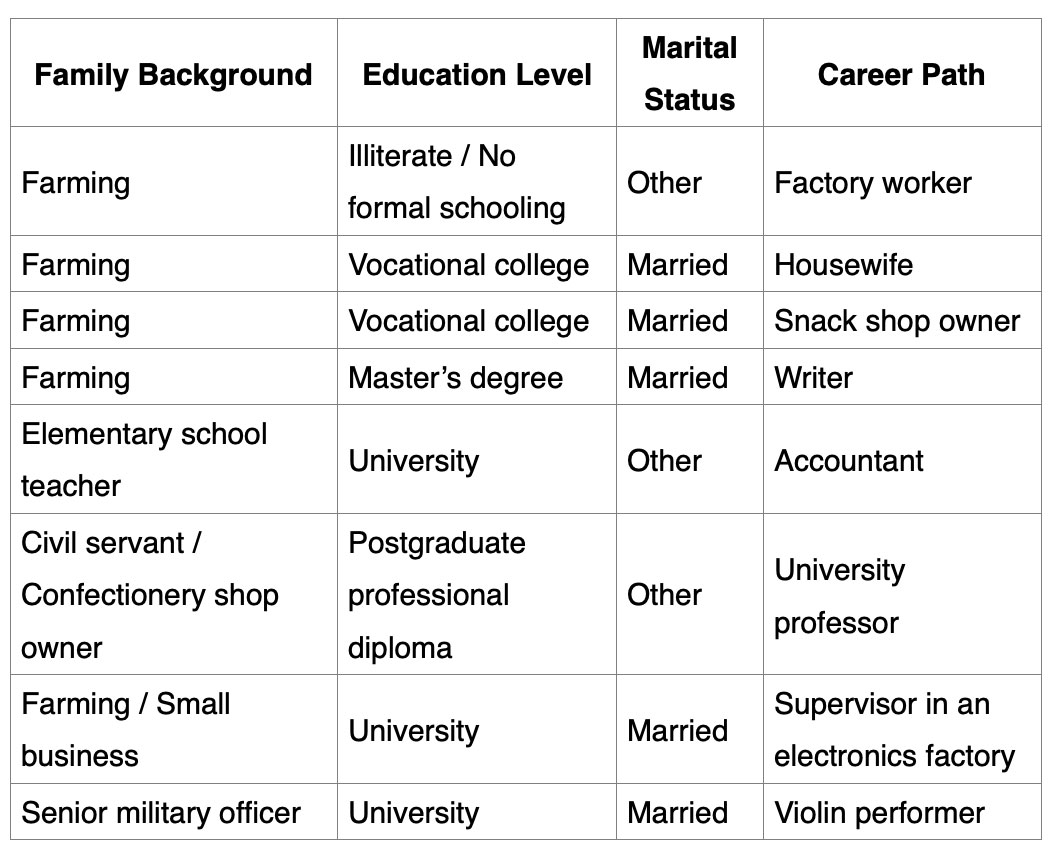
With careful aim, I slide a blade gently into Taiwanese society and cut out a thin cross-section based on age and gender to use as a sample: eight women born in the 1950s. Guided by linear time, I listen closely to their childhood family backgrounds, their educational and social experiences, their work and environments after entering society, and their present conditions. Their information can be mapped across four dimensions as follows: