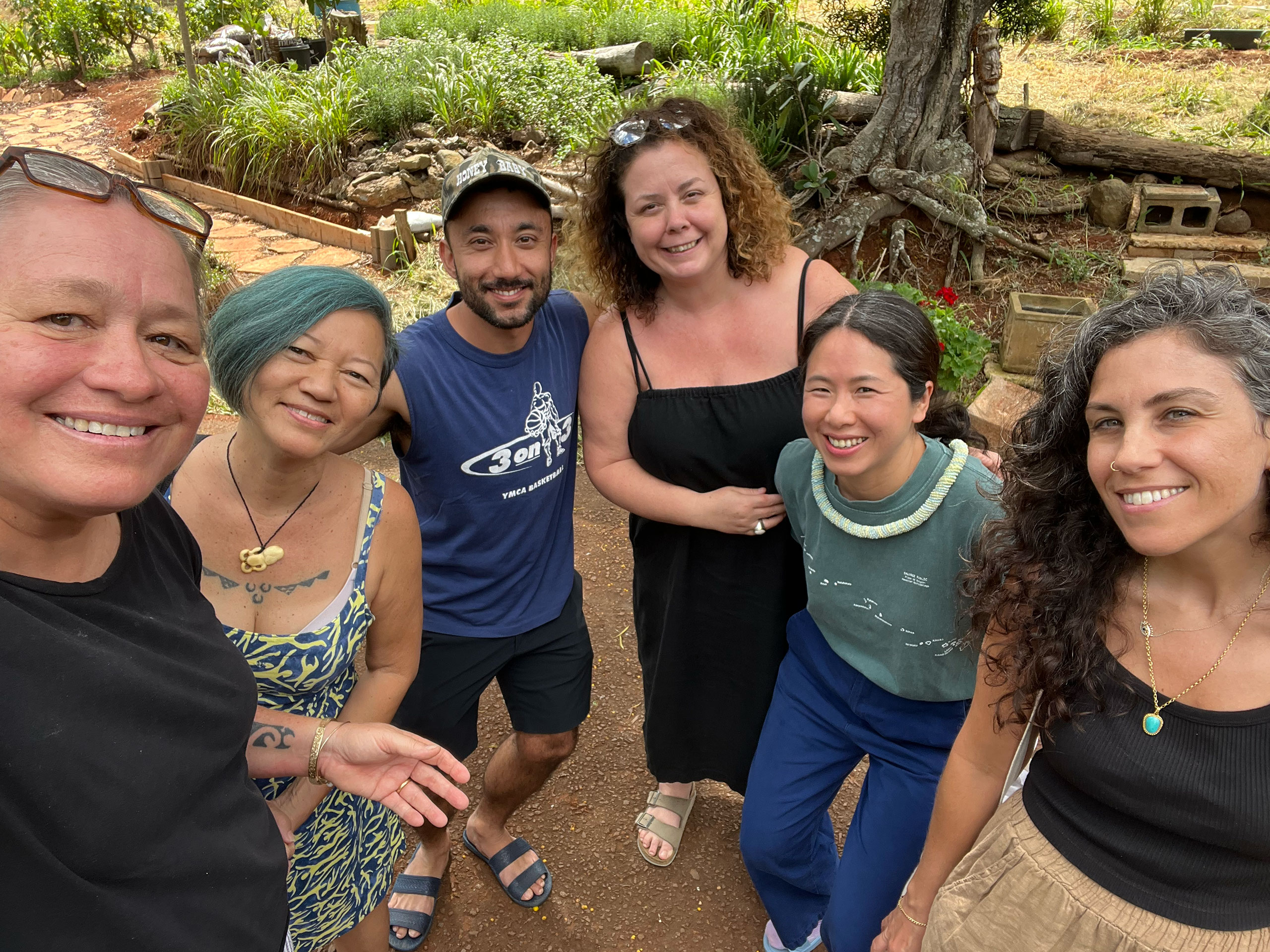
Wassan Al-Khudhairi: One of the first things we did as a curatorial team was to volunteer at the lo‘i, or taro patch, at Kākoʻo ʻŌiwi on O‘ahu—it wasn’t sitting in a meeting room talking to each other, but being in the ‘āina, and I think it grounded this process. As an outsider who had never visited Hawaiʻi, this was a transformative experience; to stop, listen, and be changed by the land. Doing this with a large group of multigenerational communities, with the both of you, and the Hawai‘i Contemporary team—being knee deep in the lo‘i, covered in mud, feet gently pressing the roots while my hands nudged the taro from the ground—anchored me ‘in’ this place. It set the tone for how we would work together and established one of the threads that I think has developed as a core part of this triennial—moʻo, the Hawaiian word for continuity or succession—as a way to remind us that everything is interconnected.
Binna Choi: Some days after a lo’i day, and with my fingernails still filled with dirt, I met Maile Meyer, founder of Native Books and a Hawai’i Contemporary board member, and shared my concern about speaking of the Hawaiian philosophy, culture, and values as a haole wahine (foreign woman). Maile assured me, saying that I had shown that I have mud in my fingernails from the lo‘i, and I am speaking from that experience and connection.
Many Hawaiian and local artists are engaging directly with ‘āina by working in the lo‘i, weaving with hala, and other conservation work. Later on, we invited local HT25 participating artists to join the lo‘i at Ulupō Nui, which is taken care of by Nālamakūikapō Ahsing, also a participating artist in HT25. He sources most of his materials for his artwork from this place, such as trees for paper and stamping and plants for color painting; there’s a reciprocal relationship between him and this particular ‘āina. I think this mode of engagement can set an example for the rest of the world!
Noelle M.K.Y. Kahanu: As someone of this place, as a Kanaka ‘Ōiwi (native Hawaiian), I have watched the artistic endeavor of the Hawai‘i Triennial growing for a decade, from a fledgling concept and prologue exhibition in 2014 to a biennial in 2017 and 2019, and the Hawaiʻi Triennial in 2022. Many in the arts community, including myself, were initially skeptical—one more Asia-Pacific event with a capital “A” and small “p”. And yet, over time, it has taken root here—a direct reflection of Indigenous curatorial representation.
A moment came when I could have chosen to remain an observer or become a part of this unfolding legacy. I said yes, despite having a largely ethnographic museum background. The contemporary art realm is sometimes mystifying, and I felt most comfortable when we were wrestling with Hawaiian concepts like our theme of aloha nō. We felt strongly that it was time to embrace a theme in ‘Ōlelo Hawai‘i (Hawaiian language) and that it did not need an English translation but could stand on its own as an invitation to learn more.
Aloha is such an over-commodified word, and we struggled with its use, circling around and away but ultimately circling back. There was a precious moment on Maui during a pre-HT25 small town-hall meeting on the grounds of the Bailey House Museum. My Auntie Ellen Raiser was there, and she said very clearly, “Aloha is something that we want to share, but something that also has to be defended.” This really solidified for me the potentialities of this theme and the creative opportunities that present themselves when we really lean into the tensions and complexities of aloha nō.
BC: As the fourth iteration, HT25 is built upon past iterations, and its meaning and how this continuity is woven through might be articulated further; otherwise, the success of a biennial or triennial is often premised on innovation and differences only. Personally, I am indebted to the 2022 edition of the Hawai‘i Triennial, Pacific Century—E Ho‘omau no Moananuiākea, curated by Drew Kahuāina Broderick, Melissa Chiu, and Miwako Tezuka, which brought me to Hawai‘i for the first time—and to HT25 artist Sung Hwan Kim for encouraging me to come—as well as to initiatives such as Native Books and Aupuni Space, which nurture the artistic and cultural ecosystem in Honolulu. In particular, the HT22 ‘Elepaio Press installation at Hawai‘i State Art Museum (HiSAM), now known as Capitol Modern, enveloped me within the context of Hawaiian anti-colonial political struggles, the importance of native and non-native collaboration, and the position of these in Moananuiākea and the broader Pacific region, alongside all kinds of connections and exchanges among artists, poets, and writers that burgeoned from the 1970s, when the so-called Hawaiian Renaissance movement rose up. Work by Wayne Kaumualii Westlake, Richard and Mark Hamasaki, and Paul L. Oliveira, including the journal Seaweeds and Constructions, was an amazing conduit for this.
Especially when I came across Westlake’s poem “Down on the Sidewalk in Waikiki” (1973) through Mark Hamasaki’s photographic montage work Down on the Sidewalk … (2021) at HiSAM, it opened a deeper sense of understanding and connection to Hawaiian history, almost like facing a wound that is healing. The poem includes the lines, “last year I spent working as a janitor down on the sidewalk in waikiki—experiences ran from everything to everything. I wrote poems to keep from going insane.” The poem captures the harm colonialism causes; but it also turns the popular colonial idea of Waikīkī upside down and shows what art can do. We might say aloha nō is imminent in the HT22 edition of the triennial, as it is in this work, or the seeds were planted and they are growing with us
WA: As someone who is new to Hawai‘i, learning about Hawaiian history and all that its people have endured in the past and continue to navigate today in an occupied place, I feel there is much to learn from Hawaiian values and traditions; that these could offer us other ways of understanding the complex world we are living in and we can use these teachings to envision new ways of being in the world with one another.
When we began thinking about HT25, we were trying to project what the local and international context would be in February 2025, knowing that there would be major global economic and political changes. Since we began work on the exhibition, the Ukraine war has continued, Israel has committed genocide in Palestine, and issues of climate change such as rising sea levels persist. The United States is on the verge of an electoral civil war where not even the presidential election process is safeguarded.
With all this uncertainty, we have been thinking about how to make a triennial that could speak to and maybe even offer up other ways of thinking about and navigating these realities. It’s challenging to make an exhibition for a future context that we canʻt predict.
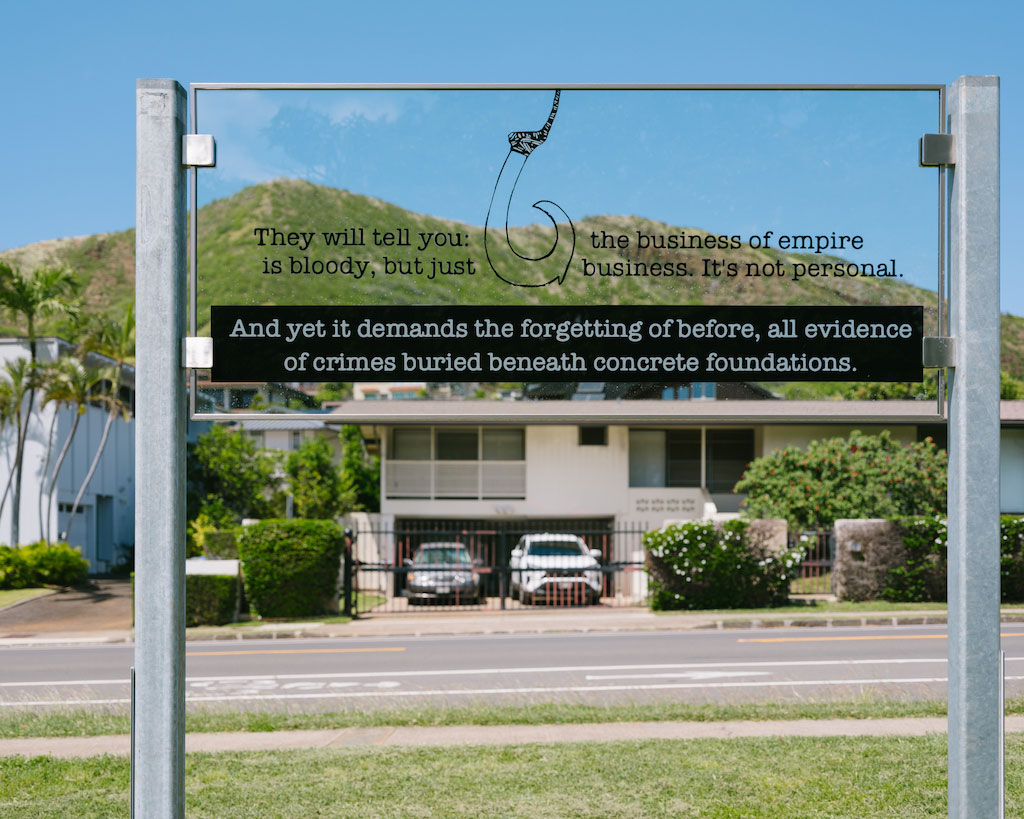
NK: I think many visitors to Hawaiʻi do not know its colonial history. At the crux is the illegal overthrow of the Kingdom of Hawaiʻi in 1893 by a handful of American and European businessmen. These opportunists took advantage of a constitutional dispute and turned it into a ‘crisis’, insisting that over 160 armed US marines be landed to protect American lives and property. Queen Liliʻuokalani yielded her authority to the United States because she feared the bloodshed of her people and because she hoped the US would soon undo this injustice. Instead, Congress illegally annexed Hawaiʻi by a simple majority through the Newlands Resolution in 1898. The normal treaty process requires a two-thirds majority of the Senate, but, because more than 38,000 Hawaiians signed petitions objecting to annexation, the first vote failed. In an act never seen before or since, the US annexed the territory of another against its will, by resolution; by a simple majority and by the same authority that Congress uses to recognize National Apple Pie Day.
I think people need to understand that the events of the past continue to live very much in the present. We hold these histories within our bodies and experience them generationally. So, as curators, we have been asking ourselves, how might a triennial be a platform by which to experience these enduring contestations? Taking a cue from this history, we even flirted for a moment with Haunani-Kay Trask’s infamous words “We are not American” as a means of saying that where this triennial takes place matters. This history matters. Such a position informed our artist selection—as we considered places with similar colonial or conflicting histories and present realities. We have attempted to take these matters to heart within the kaona (multiple meanings) of aloha nō, with “nō” being both an expression of intensification and an allusion to refusal. It has become our touchstone. We would leave, be momentarily enticed by another idea, then return.
BC: The ambivalence of the expression aloha nō is both the challenge and power of our theme; its meaning is supposed to be undulating, depending on the context and situation. For most people—both in and out of Hawai‘i—the expression might at first be read as a form of negation, unsettling the familiar and recognizable Hawaiian greeting and stereotypical image of Hawai‘i as a (holiday) paradise. In order to know the full meaning of the title, one needs to be familiar with Ōlelo Hawai‘i and understand that nō is rather a deep affirmation, intensifying the meaning of aloha.
At one point, I felt disturbed by the idea of this wordplay, and concerned that the title would appear negative for many, in a time where there is so much negativity and political instability. I am cautious that sometimes forms of resistance might fall into the logic of the enemies they resist, and I am glad that we have made sure that the emphasis is on the affirmation. Keeping the kahakō, or macron, on the nō helps people to understand there is more at stake than the English no, and we have this responsibility to lead from not knowing to knowing, from anger and resistance to deepest affirmation and love. In fact, as we learnt from Aunty Manulani Aluli Meyer, in Hawaiian epistemology, knowing is nothing but loving.
It is not an easy task to make an exhibition that enables the experience of loving, and loving as the ultimate truth. One of the challenges lies in our curatorial process and practice, which embraces an exhibition but surely goes beyond it. We have been adamant that we cannot display aloha while the process of making the exhibition is filled with that which contradicts aloha. In fact, in Aunty Manu Meyer and Nāpali Aluli Souza’s essay for the Honolulu Biennial 2017 catalogue, writing about how the exhibition can serve pilina, they ask, “Can Hawai‘i maintain the Aloha Spirit that has made us distinct in the world, or do we collapse into mainstream art rhetoric based on a-cultural assumptions of power and money?” I also love and carry with me a statement they made: “The mo’o runs throughout all of life, but she lives where aloha finds safe harbor.”
That we are centering Indigenous Hawaiian values through aloha as the source of these values also invites us to engage with the notion of tradition and traditional cultural practices. Without the ongoing conscious effort to preserve and perpetuate Hawaiian traditional practices such as kālai ki‘i, hula, storytelling, and even the language, all might have been erased. Yet, engaging with tradition, as much as with identity, can also fall into a trap of othering, xenophobia, and commodification, which I have seen in Korea and, in its extreme version, in the right-wing nationalist movements of Europe. I do love the idea that it’s aloha—love—that ensures continuity, not the definition and boundaries of tradition, not an ideology or any other logic of power. Do you remember our visit to Uncle Sam Ka‘ai in Maui, the beloved orator and cultural icon? In the same vein, it was so liberating and exhilarating to hear through his storytelling that the word Hawai‘i is not just found in Hawai‘i, but also in Aotearoa, Samoa, Tonga, and even in the Strait of Malacca; that the word “Hawai‘i” means “homeland”!